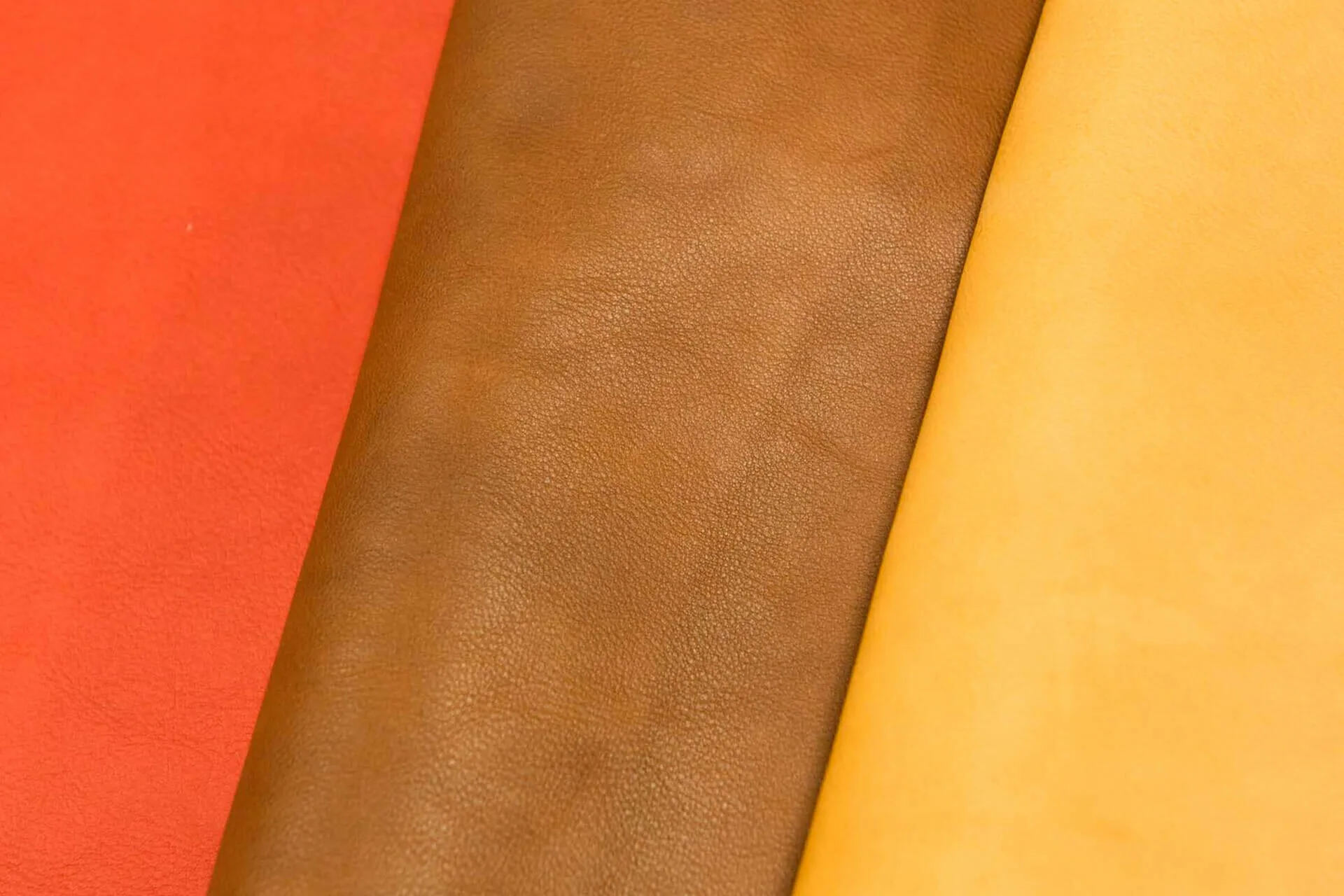
There's skill in that leather: the marks of handwork
The way eyeliner is applied can transform a face. The same is true of leather goods.
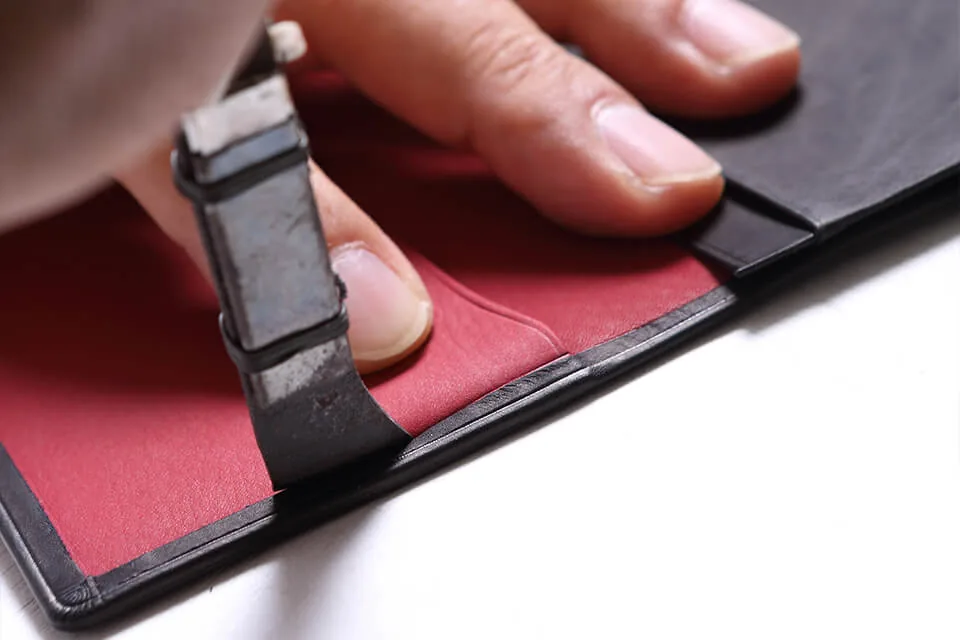
Nen (crease lines)
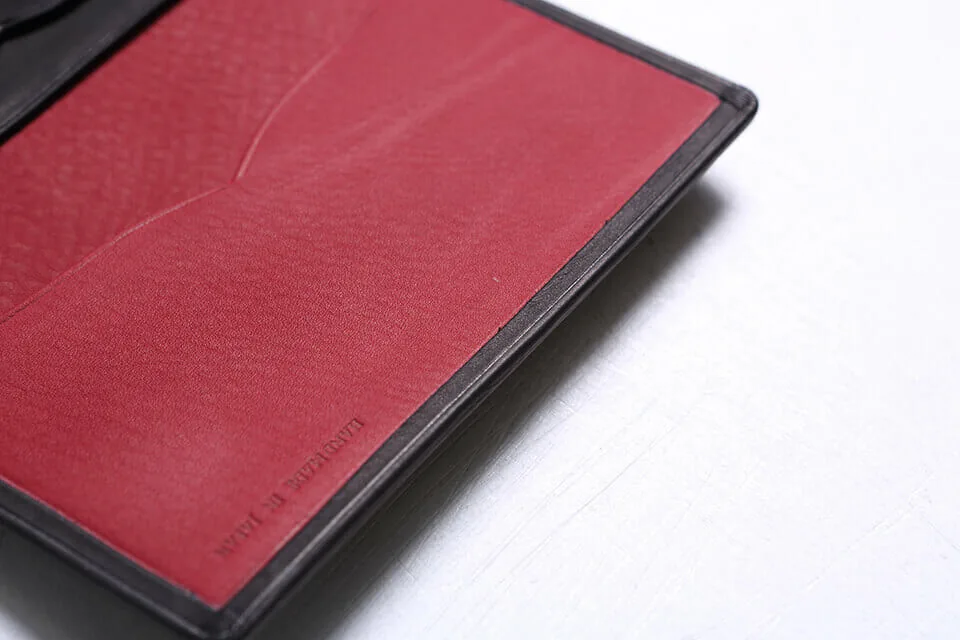
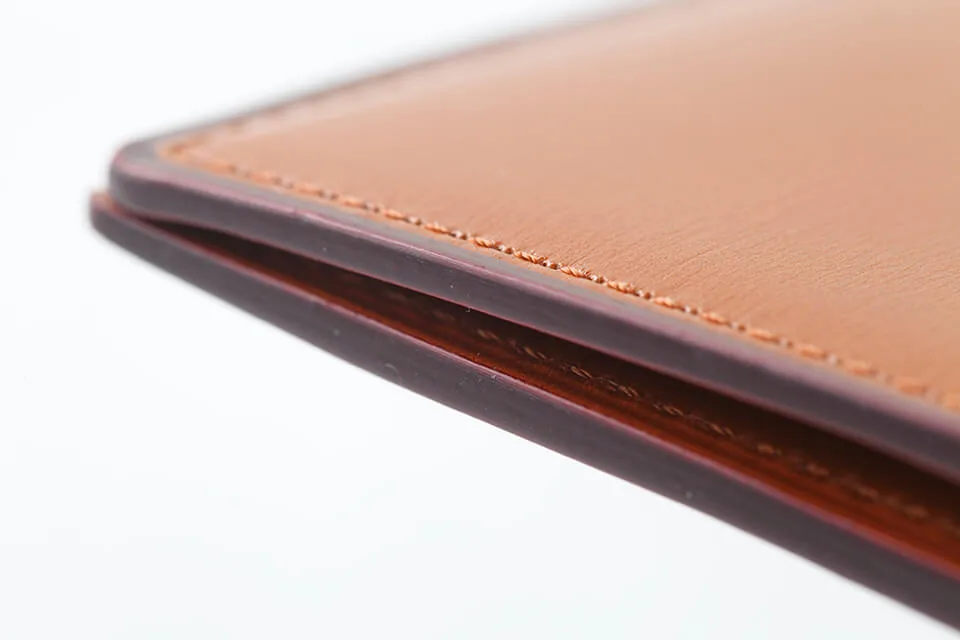
Look closely at the inside of a leather product and you will notice a single line running parallel to the edge. This line is called an “ippon-nen” (single crease line), and drawing it is one of the finishing steps. A heated creasing iron is run along the leather just a few millimeters in from the edge, which improves the adhesion of the folded edge. A straight, unwavering line also sharpens the product's overall look.
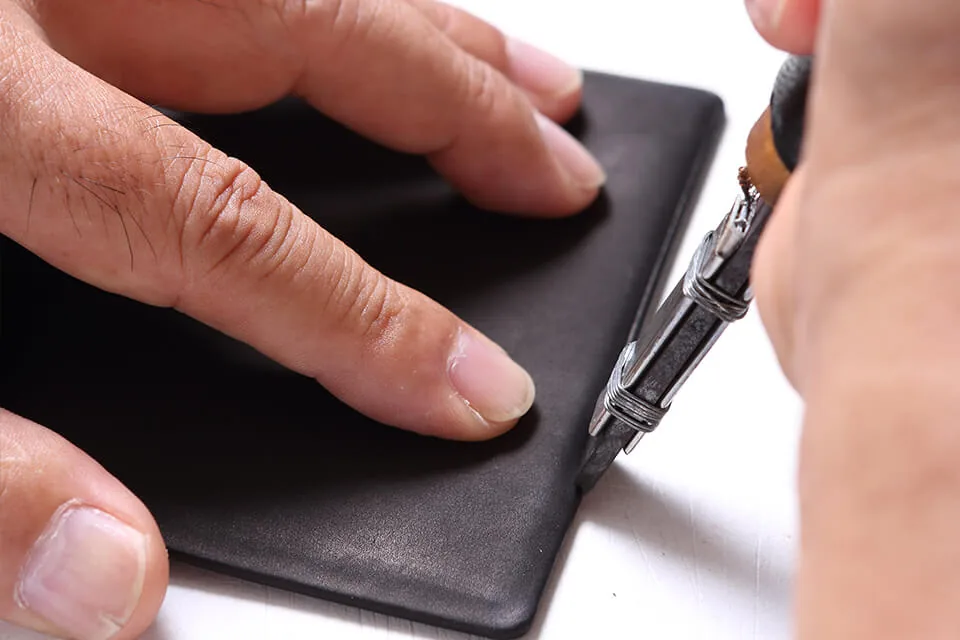
The “tama-nen” (bead crease), on the other hand, is purely decorative. This line is drawn on the outside, right beside the edge. It accentuates the edge and gives the piece a crisp, structured look, which is why some products that favor a softer feel deliberately go without it. There are other types as well, such as the double-line “nihon-nen,” and the choice depends on the image the product is meant to convey. Veteran artisans draw these lines freehand; until they are confident, apprentices are said to guide the iron carefully against a sheet of paper or the like.
Frankly, whether or not a crease line is drawn makes little difference to how a product functions. But it is precisely this dedication—taking such pains purely for the sake of ornament—that makes Japanese craftsmanship so compelling.
You sense the beauty without knowing why. Even if you look for the reason, an untrained eye rarely finds it. The artisan knows: a single line is enough to sharpen a product's expression. It is the secret that completes the whole balance.
Ippon-nen (single crease line)
The crease is drawn as close to the edge as possible. Because the edge is pressed tightly against the lining, there is nothing to catch on, and the piece feels better in the hand.
Tama-nen (bead crease)
Compared with the ippon-nen, the tama-nen line is somewhat wider. Once drawn, it creates a three-dimensional relief on both the outer and inner sides of the line.
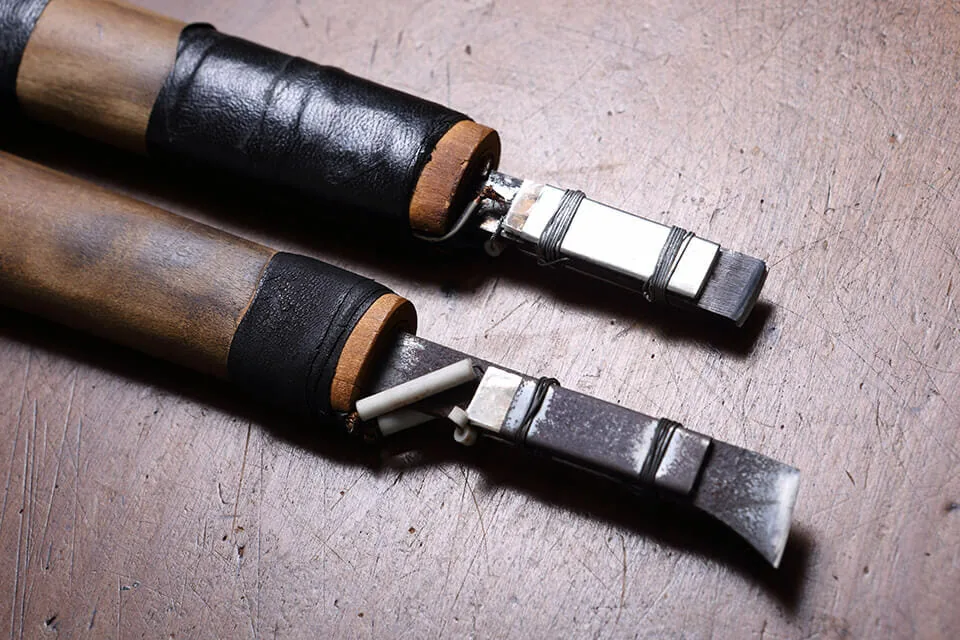
Creasing irons
Different irons are used for different creases: the one at the top is for the tama-nen, the one below for the ippon-nen. The artisans shape the tips themselves, for example by grinding down a knife blade, and heat them with a transformer or similar device before use.
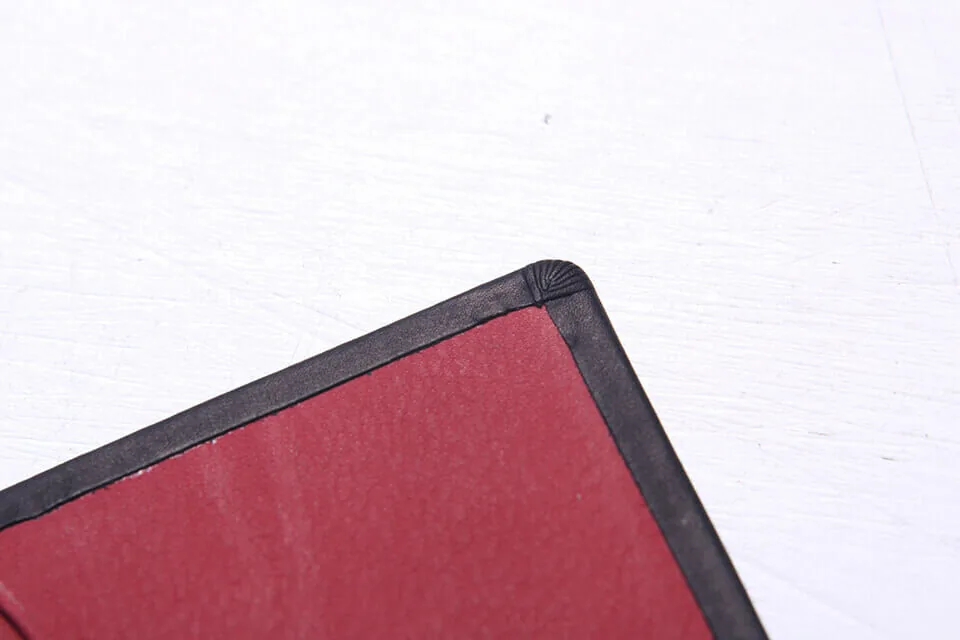
Kikuyose (chrysanthemum pleating)
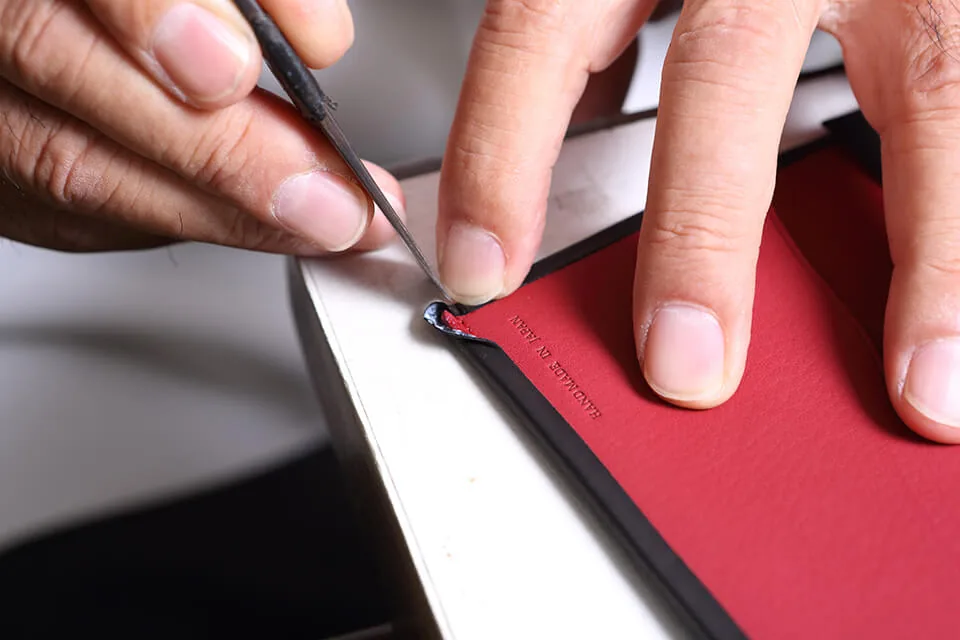
God is in the details, and artisans pour their heart and soul into finishing those details beautifully. In that sense, “kikuyose” is where an artisan's skill truly shows. Kikuyose is the technique of gathering the leather into radiating pleats at the corners of a turned-edge product. Because the finished corner resembles a chrysanthemum (kiku), it was given this elegant name; it is also called “kizami.” It is mainly applied to products with rounded corners, and pleating by a practiced hand has a beauty all its own.
The basic process is to skive the corner area thin so that it folds cleanly, then carefully fold the leather inward. Folding the excess leather that gathers at the corner into natural pleats demands a high level of skill—so much so that it is said, “if you can do the pleating, you can be trusted with everything else.” Incidentally, the number of pleats varies from product to product, but an odd number is considered best balanced.
The Japanese word for pleat, hida, also means a fold in the figurative sense: as in kokoro no hida, “the folds of the heart,” it describes subtle shades of feeling. Kikuyose is a technique that holds both meanings at once. Try looking at the corners of the leather goods around you. In those carved pleats, you should be able to sense the artisan's delicate aesthetic sensibility.
A technique for tidying things up neatly. But an artisan's temperament never lets it end there. With well-worn hands and tools, and a delicate sense of beauty devoted to every detail, they make a leather product bloom.
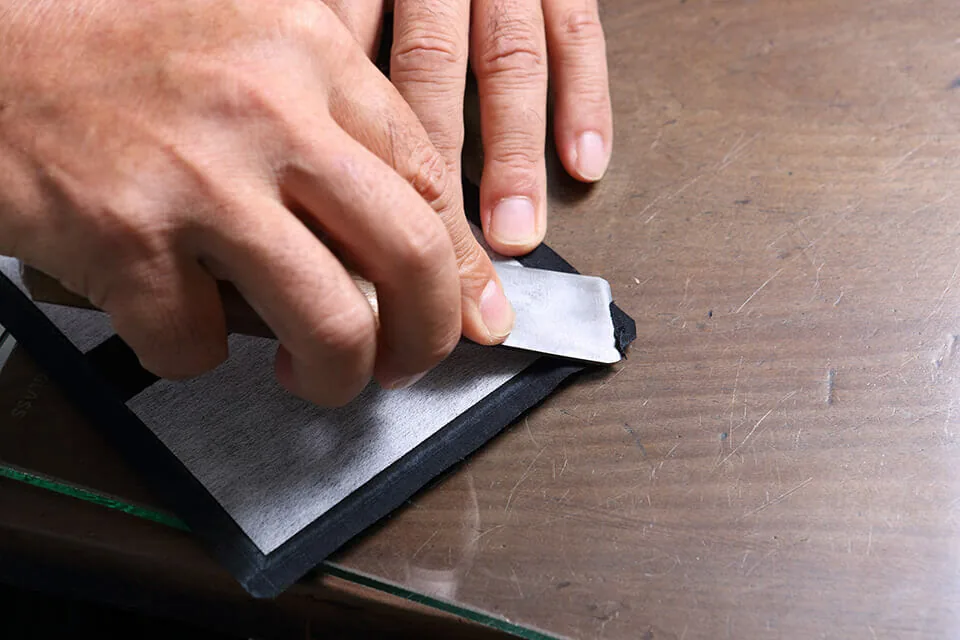
Hand skiving
The leather is skived thin so that the edge can be turned cleanly. How much to skive is judged by the feel of an experienced artisan, and the quality of this step determines how the rest of the finish turns out.
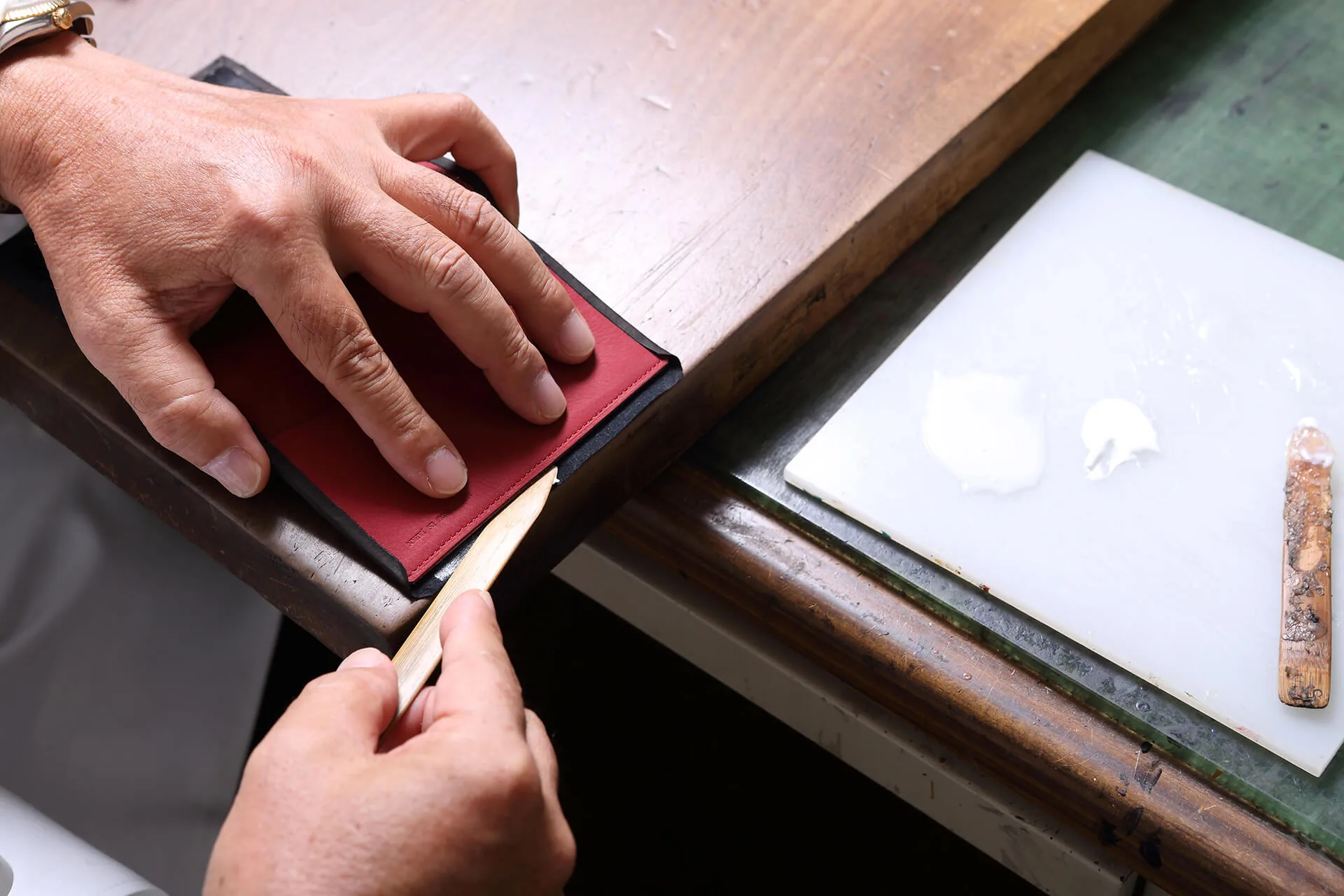
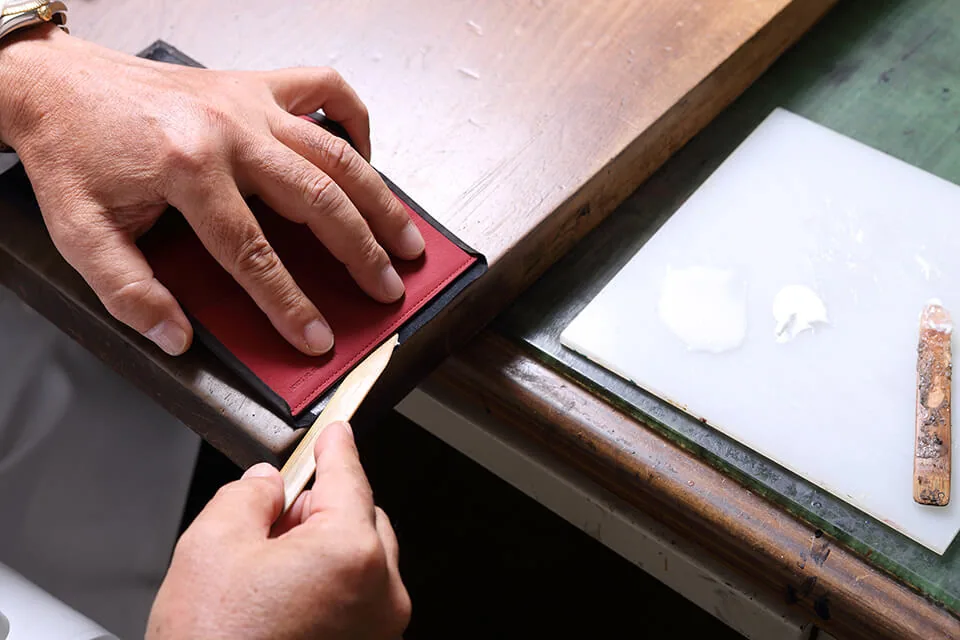
Edge turning
Glue is applied with a spatula, taking care to keep it even. The leather along the side is then folded inward over the cut edge to wrap it. The key is to keep the turned width uniform.
Kikuyose
Using a tool called a yose-nen, the artisan works neat pleats into the corner one by one. Pressing firmly with the tool bonds them to the leather beneath.
Edges (koba)
The cut surface of leather is called the edge, or koba in Japanese. The name is said to come from koba meaning “wood end,” because the raw cut looks like wood grain—but leather rarely goes out into the world with its edges left raw. What we usually see are edges that have been beautifully finished through the artisan's meticulous techniques.
Edge finishing falls broadly into two types: the “cut edge” and the “turned edge.” In the former, the cut surface itself is smoothed and colored; in the hands of a skilled artisan, several layers of leather can be made to look like a single piece. Trim, burnish, paint. The canvas is tiny, and the work is done carefully and evenly, with painstaking attention.
The “turned edge,” on the other hand, folds the outer leather over the inner leather and glues it down. Since the cut surface is hidden, the whole piece looks cleaner. There are other options, too, such as “kaeshi-awase,” in which two pieces of leather with turned edges are joined together, and “nui-kaeshi,” in which the leather is sewn from the back and then turned right side out. The choice depends on the type of product and the feel it is meant to have.
It is only an edge—and yet it is everything. How the edge is finished changes the impression of the whole product. The sheer variety of methods speaks to how much the edge matters.
At the very end, the making that began with tanning reaches its goal here. That is why the responsibility is so great. Polished until the artisan is satisfied, a masterpiece is born.